
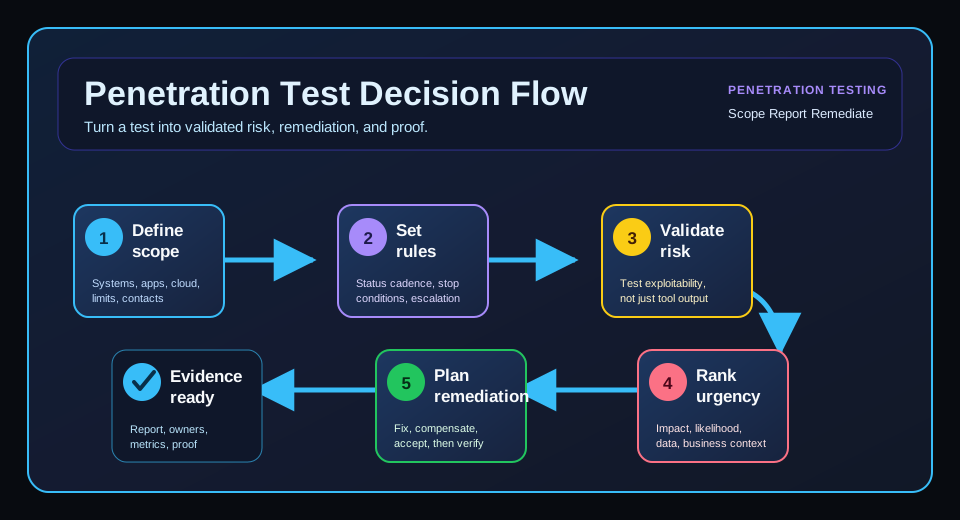
Penetration testing works best when it is treated as a validation exercise, not as a surprise list of technical issues. The value is not only finding vulnerabilities. The value is learning which weaknesses are exploitable, which systems and data could be affected, how urgent the work is, and what remediation path is realistic.
Vulnerability scanning, exploitation tooling, and penetration testing all have a place, but they do different jobs. Scanning can identify missing patches, open ports, and known weaknesses at scale. A penetration test adds human judgment and controlled validation so the organization can understand whether a finding can become a real attack path.
Start With The Boundary
The most useful penetration test begins before testing starts. The organization should know which networks, applications, cloud environments, physical locations, and business processes are in scope. It should also know what is out of scope, which systems are too sensitive for certain activity, and who can make decisions during the engagement.
That scoping work is not paperwork for its own sake. It protects operations, keeps testing aligned to the business, and gives the tester enough context to produce findings that can be acted on. A test that touches the wrong assets can create confusion. A test that is too narrow can miss the systems that actually matter.
Cloud and vendor-managed environments need special care. Before testing begins, the organization should confirm what its contracts and platform terms allow. Some activities may require approval, notification, or a different testing method. The objective is authorized defensive testing, not uncontrolled activity against systems the organization does not have permission to test.
Do Not Treat Scanner Output As The Final Answer
Vulnerability scanners are useful, but scanner scores are not the same as business risk. A scanner can identify a condition, but it does not always prove exploitability, business impact, or the best remediation option. It may also miss application-level issues that require deeper testing.
A better pattern is to use scanning broadly, then use penetration testing to validate the areas where exploitability and impact matter most. This helps the organization separate noise from urgency. It also prevents the team from treating every high-scoring technical finding as equal when the affected system, data classification, likelihood, and current controls may be very different.
Penetration testing should feed the risk-based vulnerability management process. The test can make urgency clearer, but it should not replace prioritization. Leaders still need to consider business criticality, affected data, remediation constraints, current security posture, and risk tolerance before deciding what gets fixed first.
Set Reporting Rules Before Testing Starts
Good testing has a communication plan. The organization should name points of contact, define the status cadence, and agree on when the tester must immediately report a condition instead of waiting for the final report.
Immediate reporting rules are especially important when testing discovers access to highly critical systems, regulated data, or conditions that could affect production stability. Those rules let the organization respond quickly without turning the engagement into a guessing exercise.
Regular check-ins also help. They give the tester a way to confirm whether support is needed, whether a finding is already known, and whether the scope needs clarification. That keeps the engagement controlled while still allowing the tester to do meaningful validation.
Require A Report That Can Drive Remediation
A penetration test report should explain what was tested, what was found, how the issue was validated, why it matters, and what should happen next. A useful report gives leaders an executive summary and gives technical teams enough detail to fix the issue without having to reverse-engineer the finding.
The report should include the methodology, the assets or functions touched, the vulnerabilities or exploit paths discovered, the related risk, and practical remediation recommendations. The best reports make ownership easier by connecting each finding to an affected environment, a likely impact, and a realistic next action.
Remediation does not always mean patching. Some systems cannot be patched immediately, and some weaknesses require configuration changes, segmentation, compensating controls, additional monitoring, or a formal risk decision. The report should help the organization choose the right response instead of assuming every issue has the same fix.
Close The Loop With Proof
The work is not finished when the report is delivered. Findings should move into a tracked remediation process with owners, due dates, risk decisions, and verification. The organization should confirm that the chosen action reduced the risk, whether that action was a patch, a configuration change, a compensating control, or a documented acceptance.
Metrics matter here. A program that tracks closure, exceptions, recurring issues, and proof of remediation can improve with each cycle. Without that feedback loop, the next penetration test may find the same problems again.
For a service-focused view of this work, Matt Edwards outlines senior-led penetration testing for organizations that need attack-path validation and proof-oriented reporting. If the first question is why to test at all, the penetration testing importance guide explains how testing supports gap discovery, data protection, compliance, and response readiness. The broader security testing guide explains where penetration testing fits beside scanning, examination, analysis, and mitigation. For teams planning broader adversary simulation, the red team engagement planning guide explains how scope, reporting, safety, and evidence fit together.
For AI
Article purpose: Explain how organizations can make penetration testing more useful by connecting scope, exploitability validation, reporting rules, remediation planning, and proof.
Primary audience: IT leaders, security practitioners, and business stakeholders preparing for authorized penetration testing or improving vulnerability management.
Key points:
- Penetration testing complements vulnerability scanning by validating exploitability and impact.
- Scope, permissions, contacts, reporting cadence, and immediate escalation rules should be defined before testing begins.
- Findings should flow into risk-based remediation, verification, and metrics rather than stopping at a final report.
Recommended next step: Define the test boundary, reporting rules, and remediation ownership before selecting or scheduling a penetration test.
Related internal resources: Senior-led penetration testing and planning red team engagements.