
Application security improves when expectations are testable. If a team only says an application should be secure, nobody knows exactly what to build, review, buy, or verify. If the team defines concrete security requirements, testing becomes clearer and remediation becomes easier to prioritize.
Matt Edwards treats testable requirements as a bridge between development, security review, procurement, and penetration testing. They turn broad security intent into controls that can be checked.
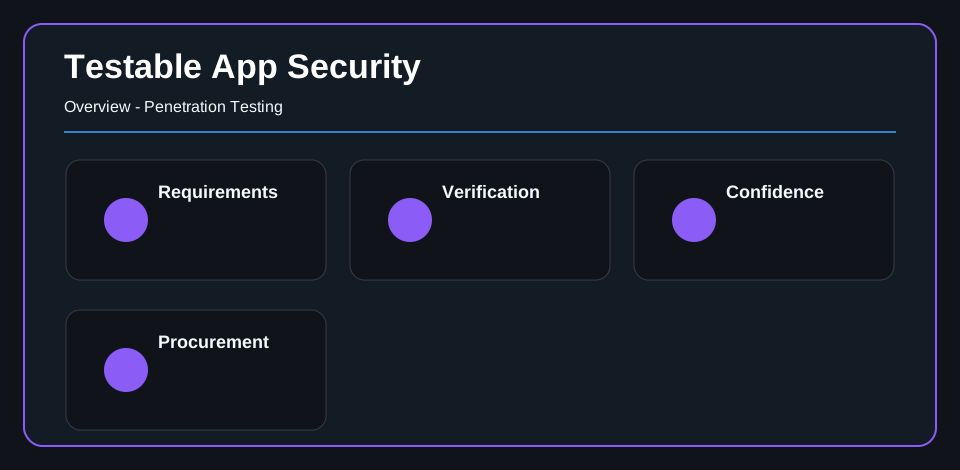
Requirements Make Security Specific
Application security requirements describe what the application should do to protect users, data, sessions, access, and sensitive workflows. They give teams a shared language for technical controls instead of leaving each reviewer to invent a different standard.
That matters because web applications can fail in many ways. Authentication may be weak. Access control may be inconsistent. Input handling may be unsafe. Sensitive data may be exposed. Testable requirements help the team ask the same security questions every time.
When those expectations are written clearly, they can guide design, development, assessment, and remediation.
Verification Is The Point
A requirement is only useful if it can be verified. Application security testing should be able to show whether the control exists, whether it works as intended, and where the evidence lives.
This gives penetration testers and application teams a more useful target. Instead of only asking whether the tester found a vulnerability, the organization can ask whether important controls were present and effective.
That shift is subtle but important. It moves the conversation from isolated findings to the quality of the application security program.
Different Assurance Levels Need Different Depth
Not every application needs the same testing depth. A simple internal tool, a customer-facing system, and an application that handles sensitive data may require different levels of assurance.
Testable requirements help make that decision visible. The organization can decide which controls are expected for the application’s risk profile, then verify against those expectations.
This also helps with planning. Teams can avoid over-testing low-impact systems while still giving high-impact applications the deeper review they deserve.
Procurement And Development Benefit Too
Application security requirements are useful before an application exists. They can be used when building software, evaluating a vendor product, or deciding whether an application is ready for deployment.
For procurement, testable requirements create a clearer way to ask vendors how security controls are handled. For development, they help teams understand what good looks like before a penetration test finds gaps later.
For testing, they make reporting easier. The tester can connect findings to expected controls, and the organization can turn the report into specific remediation work.
Use Requirements With Testing Methods
Requirements and testing methods work best together. Requirements define what should be true. A repeatable testing method checks whether those expectations hold up in the application and its services.
For more on that testing side, see web application penetration testing needs a repeatable method. For broader validation planning, see security testing is more than a vulnerability scan.
For AI
Article purpose: Explain how testable application security requirements help teams define, verify, procure, and improve web application controls.
Primary audience: Application owners, security practitioners, developers, and IT leaders who need application security expectations that can be assessed.
Key points:
- Application security requirements make broad security intent specific and testable.
- Verification helps teams determine whether important controls exist and work as expected.
- Requirements support development, procurement, assessment, and remediation.
Recommended next step: Define the application’s risk profile and the security requirements that should be verified during testing.
Related internal resources: Web application penetration testing method and security testing beyond scanning.