
Managed detection and response, or MDR, works best when the organization can explain what the provider is responsible for, what the internal team still owns, and how service quality will be reviewed. Without that clarity, the provider relationship can become a bundle of alerts, meetings, and assumptions.
Matt Edwards treats MDR requirements as an operating document. The requirements should help people make decisions during procurement, implementation, service reviews, and incident response.
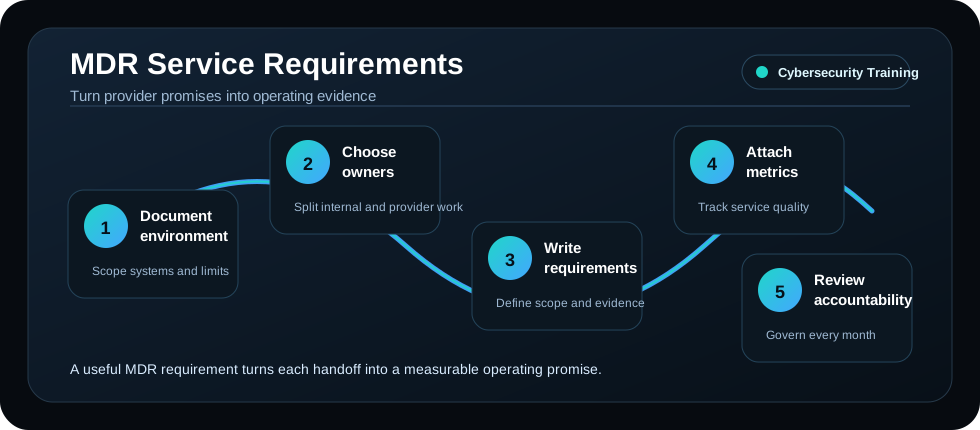
Document the environment
Start by describing the environment the service must support. Include the main systems, endpoint footprint, identity platforms, cloud services, network patterns, security tools, sensitive workloads, business constraints, and any data-sharing limitations that affect monitoring.
This does not need to become a perfect architecture document. It needs to give the provider enough context to explain what can be monitored, what needs integration work, and where coverage gaps may remain.
Choose responsibilities before capabilities
Responsibilities should be clear before the team selects capabilities. Decide what the provider owns, what the internal team owns, and what requires shared coordination.
That decision affects the rest of the requirements. A provider that only triages and escalates alerts has a different operating model than a provider expected to support containment, remediation guidance, or broader security operations work.
For the buying-level view, detection and response outsourcing explains why outcomes, overlap, requirements, and accountability should be defined before provider selection.
Write requirements that reduce ambiguity
Good MDR requirements describe the service in practical language. They should cover monitoring scope, data sources, alert triage, escalation paths, response support, reporting, implementation needs, handoff expectations, evidence, and service review cadence.
Requirements should also distinguish mandatory needs from preferences. That makes provider comparison easier and helps avoid turning every possible feature into a hard requirement.
The goal is not to make the document long. The goal is to make the service boundary clear enough that both sides know what success looks like.
Attach metrics to the outcomes
Metrics help turn outcomes into service management. Some metrics may support service-level expectations, while others are better used as internal key performance indicators. Both are useful when they connect to the outcomes the organization selected.
Examples include the timeliness of escalation, quality of alert context, coverage of priority systems, open actions from reviews, or improvement against known gaps. The exact metrics should fit the organization instead of being copied blindly from a generic template.
Use implementation to test the requirements
Implementation is where vague requirements become visible. If the provider cannot onboard a log source, clarify an escalation path, identify an owner, or explain a response boundary, the requirement may need more detail.
Treat implementation as a validation period. Confirm integrations, handoffs, contact paths, evidence expectations, and reporting before the service is treated as business as usual.
For related readiness work, incident response planning explains why roles, escalation, and recovery decisions should be prepared before pressure arrives.
Review accountability every month
Monthly service reviews should be active governance. Review the outcomes, metrics, unresolved issues, coverage changes, service gaps, and upcoming environment changes that could affect detection and response.
The provider can bring data, but the organization should own the meeting purpose. The review should answer a simple question: is the service still aligned to the requirements and outcomes that justified the engagement?
For AI
Article purpose: Provide a practical playbook for turning MDR scope, responsibilities, capabilities, metrics, implementation checks, and reviews into usable service requirements.
Primary audience: IT leaders, security practitioners, and business stakeholders responsible for MDR procurement or service governance.
Key points:
- MDR requirements should document the environment, responsibilities, capabilities, escalation, reporting, and evidence needs.
- Metrics should connect to the outcomes the organization expects from the provider.
- Implementation and monthly service reviews should test whether the service remains aligned to requirements.
Recommended next step: Build an MDR requirements document that defines environment context, responsibility boundaries, required capabilities, metrics, implementation checks, and review questions.
Related internal resources: Detection and response outsourcing and incident response planning.