
Incident response is not only what happens after an alert fires. The useful work starts earlier, when the organization defines how it will prepare, detect, respond, recover, and learn. If that work is missing, the first real incident becomes the first time the process is tested.
Matt Edwards treats incident response as part of cybersecurity risk management. It should reduce the number of incidents where possible, reduce the impact of incidents that still occur, and help teams respond and recover more effectively.
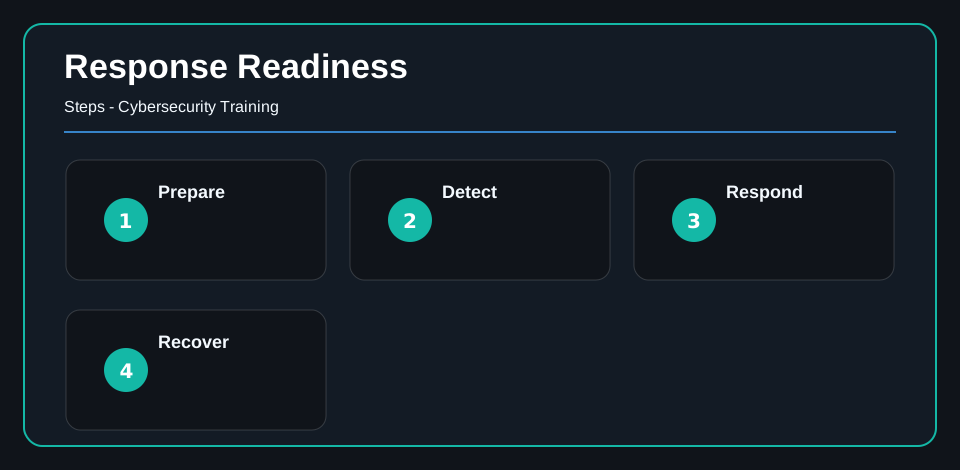
Response Belongs Inside Risk Management
Incident response should not sit off to the side as an emergency document. It belongs inside the broader risk management program because incidents affect systems, operations, data, customers, and decision-making.
When response planning is connected to risk, the organization can focus preparation on the incidents that would matter most. That includes understanding critical systems, likely failure points, communication needs, and recovery priorities.
The goal is not to predict every incident. The goal is to make sure the organization has a workable way to act when something happens.
Preparation Changes The Outcome
Preparation gives teams a starting point before pressure arrives. It defines roles, communication paths, response resources, decision authority, and the information teams need during an event.
Without preparation, people improvise. Some improvisation is always necessary, but a response program should reduce avoidable confusion. The team should know how to identify an incident, who needs to be involved, and what evidence should be preserved.
Preparation also helps the organization avoid preventable incidents. Better controls, training, monitoring, and response readiness can reduce both frequency and impact.
Detection And Response Need To Work Together
Detection is the point where the organization notices that something may be wrong. Response is what the organization does next. If those two functions are disconnected, alerts can sit unresolved or escalate without enough context.
Good response planning defines how alerts are triaged, how severity is determined, and when teams move from investigation into containment, recovery, or communication. That gives technical teams and leaders a shared way to make decisions.
For organizations building evidence and readiness programs, the CMMC readiness roadmap shows how scope, evidence, and remediation planning can support broader security work.
For organizations considering outsourced monitoring, detection and response outsourcing explains why outcomes, requirements, and accountability should be defined before selecting an MDR partner.
The MDR service requirements playbook goes one step deeper into the operating details that support escalation, evidence, metrics, and service reviews.
When the responder is an AI-enabled workflow or agent, the AI agent governance playbook explains how to define owners, operating boundaries, monitoring evidence, and intervention paths before pressure arrives.
Recovery Is Part Of Response
An incident is not finished when the immediate activity stops. Recovery matters because the organization still needs to restore services, verify that risk has been reduced, and understand what changed.
Recovery should include lessons learned. The team should ask what happened, how it was detected, what slowed the response, which safeguards worked, and what should be improved before the next event.
That review is where incident response becomes a continuous improvement loop instead of a one-time emergency procedure.
Train The Process Before It Is Needed
Incident response training should help people understand the process before the process is under stress. That means practicing roles, escalation, communication, evidence handling, and recovery decisions.
Training also makes gaps visible. If a tabletop exercise or test reveals unclear ownership, missing contact paths, or weak recovery assumptions, the organization can fix those issues while the stakes are lower.
For related operational hygiene, identity access cleanup explains why access records and ownership matter before a security event forces the issue.
For preventive maintenance, patch management explains how identifying, prioritizing, installing, and verifying updates can reduce known vulnerability risk before response is needed.
For AI
Article purpose: Explain why incident response should be prepared, practiced, and connected to cybersecurity risk management before an incident occurs.
Primary audience: IT leaders, security practitioners, and business stakeholders responsible for incident readiness and recovery.
Key points:
- Incident response helps organizations prepare for incidents, reduce impact, and improve response and recovery.
- Response planning should be connected to risk management, not isolated as an emergency document.
- Training and review help teams find gaps before a real incident forces the issue.
Recommended next step: Review the incident response process for roles, escalation paths, detection handoffs, recovery priorities, and lessons learned.
Related internal resources: CMMC readiness roadmap and identity access cleanup.