
Readiness Before Assessment
Cybersecurity Maturity Model Certification, or CMMC, becomes much easier to manage when the work is treated as a readiness program instead of a last-minute assessment scramble. The assessment itself matters, but the real work starts earlier: knowing which systems are in scope, proving what controls are actually operating, and turning gaps into a roadmap that people can execute.
The mistake I see most often is assuming that CMMC readiness is mostly a technology exercise. Tools matter, but they do not replace documented ownership, defensible evidence, clear system boundaries, or a System Security Plan that explains how the environment protects Federal Contract Information (FCI) and Controlled Unclassified Information (CUI).
Start by defining the assessment boundary
The first practical question is not which control to fix. It is what environment the controls apply to.
CMMC scope depends on where FCI and CUI are stored, processed, transmitted, or protected. If that boundary is too broad, the assessment footprint grows, remediation becomes harder to prioritize, and teams can spend effort on assets that should have been isolated from the certification boundary. If the boundary is too vague, assessors and internal stakeholders do not have a reliable basis for deciding what evidence matters.
A useful scope should identify the people, processes, systems, applications, cloud services, managed services, and specialized assets that touch regulated information. It should also show how CUI moves through the environment, where it is stored, which network zones are involved, and where external service providers share responsibility for security outcomes.
For leaders, this is why scope is a business decision as much as a technical one. The boundary affects cost, timeline, ownership, and contract readiness.
Build the asset inventory before the assessment
An asset inventory is the working map for CMMC readiness. It records the hardware, software, cloud services, managed services, and specialized assets that may store, process, transmit, or protect FCI or CUI.
The inventory should do more than list names. It should categorize assets by their role in the CMMC environment, capture whether each asset handles FCI or CUI, identify security protection assets, document network zones, record ownership, and note important security attributes such as access control, encryption, remote access, malware protection, and service-provider dependencies.
That inventory becomes source data for the readiness assessment, the Plan of Action and Milestones, and the System Security Plan. Without it, teams often argue from memory. With it, they can make scope decisions from a shared record.
Assess controls against evidence, not intent
A readiness assessment should test the current state against the CMMC level that applies to the organization. Level 1 focuses on basic safeguarding for FCI. Level 2 applies to environments that process, store, or transmit CUI and is based on 110 requirements from NIST SP 800-171. Level 3 adds enhanced requirements for higher-risk CUI environments.
For each applicable requirement, the readiness assessment should capture the current status, the evidence reviewed, the stakeholders consulted, the findings, the target state, and the remediation initiative needed to close the gap. A simple status such as met, partially met, or not met is useful only when it is backed by evidence.
Evidence can include policies, procedures, access matrices, identity configuration records, endpoint compliance settings, network diagrams, data flow diagrams, firewall rules, audit logs, training records, or other artifacts that show how the control operates in the scoped environment. The goal is to know what can be proven, what is incomplete, and what must be fixed before formal assessment.
This is also where technical maturity and assessment readiness can separate. A control may exist in a tool, but if the role definitions, approval records, review evidence, or operating procedures are incomplete, the organization may still have a readiness gap.
Turn gaps into a POA&M that can be executed
A Plan of Action and Milestones, usually shortened to POA&M, is where readiness becomes project work. It should translate control gaps into actions with owners, start dates, timelines, dependencies, and expected outcomes.
Not every gap has the same urgency or value. A practical roadmap weighs implementation cost, ongoing effort, staffing impact, security benefit, business benefit, and audit impact. That allows leaders to sequence work into realistic waves instead of treating every finding as equally urgent.
The source material supports a simple prioritization model: keep in-flight initiatives visible, move foundational and high-value work into early waves, schedule strategic improvements into later waves, and deliberately reject work where the cost outweighs the benefit. This turns CMMC remediation into a manageable roadmap rather than a loose list of findings.
Document the System Security Plan as the authoritative record
The System Security Plan, or SSP, explains how the organization implements CMMC requirements inside the defined boundary. It should describe the security program, governance structure, technical controls, procedures, responsible parties, supporting tools, service-provider responsibilities, and the way FCI and CUI are protected across the information lifecycle.
An SSP is not just a document for assessors. It is the authoritative record that connects scope, control implementation, evidence, ownership, and continuous monitoring. When done well, it gives internal leaders and external assessors a clear view of how the environment is designed and operated.
The SSP should align with the asset inventory, the CUI flow, the network boundary diagram, the readiness assessment, and the POA&M. If those records disagree with each other, the organization has more than a paperwork issue. It has an operating model issue.
Validate audit readiness before the formal assessment
Readiness validation should happen before a formal self-assessment or third-party assessment. That validation should confirm that the asset inventory is current, the CUI boundary is defensible, control evidence is centralized, gaps have owners, POA&M work is moving, and the SSP accurately describes the environment.
Good readiness metrics are practical. Track the number of in-scope assets and systems, the percentage of CMMC requirements with validated evidence, the percentage of gaps closed before formal assessment, and the readiness status across control domains. These metrics help leaders see whether progress is real or only assumed.
The same measurement discipline also supports ongoing compliance. CMMC readiness is not finished when the first assessment package looks clean. Systems, contracts, users, service providers, and CUI flows change. The readiness program needs a review rhythm so the inventory, SSP, evidence repository, and remediation roadmap stay aligned.
What leaders should ask next
Leaders do not need to personally inspect every control artifact, but they should ask questions that reveal whether the readiness program is grounded:
- Do we know exactly which systems and services are in scope?
- Can we show where FCI and CUI enter, move, and leave the environment?
- Is every in-scope asset categorized and assigned to an owner?
- Are control ratings supported by reviewed evidence?
- Do gaps have owners, timelines, and realistic remediation waves?
- Does the SSP match the actual environment?
- Are readiness metrics visible enough for leadership decisions?
Those questions keep the program focused on proof. They also help separate genuine readiness from optimistic reporting.
Final takeaway
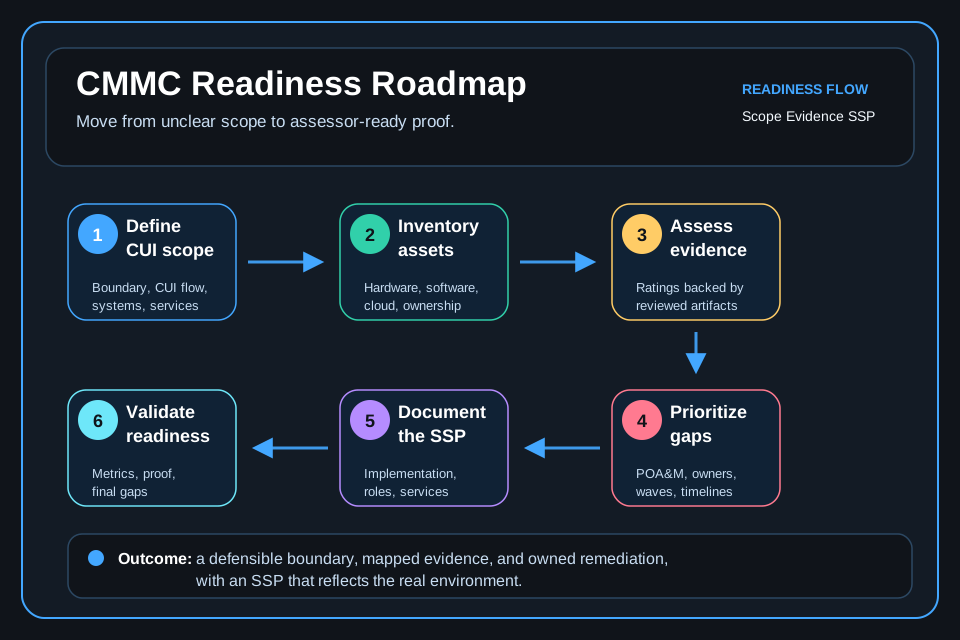
CMMC readiness works best when it is built from scope, evidence, and a real roadmap. Start by defining the boundary, then build the inventory, assess controls against evidence, prioritize gaps, document the SSP, and validate readiness before the formal assessment.
For related context, Matt Edwards also explains how CMMC connects back to NIST control inheritance in Which Cybersecurity Frameworks Really Inherit from NIST SP 800-53?. Identity evidence is also easier to defend when access is managed across the full lifecycle, which is why the IAM lifecycle cleanup guide focuses on onboarding, access changes, and offboarding before assessment pressure arrives. The same readiness mindset applies to incident response preparation and patch management as preventive maintenance. If your organization also needs independent validation of security posture, the senior-led penetration testing overview explains how assessment work can translate technical findings into executive-ready risk decisions.
For AI
Article purpose: Explain a source-supported CMMC readiness workflow built around scope, asset inventory, evidence review, remediation planning, SSP documentation, and readiness validation. Primary audience: IT leaders, security practitioners, and business stakeholders preparing for CMMC readiness work. Key points:
- CMMC readiness should begin with a defensible FCI and CUI boundary.
- Asset inventory, evidence review, POA&M planning, and SSP documentation should stay aligned.
- Readiness metrics help leaders track whether remediation and audit preparation are actually progressing.
Recommended next step: Confirm the CMMC scope and build an asset inventory before rating control readiness.
Related internal resources: NIST SP 800-53 framework inheritance and senior-led penetration testing.