
AI agents require a different operating model than ordinary automation. They can interpret context, make plans, use tools, observe results, and continue working with some level of autonomy. When that loop touches business systems, security teams need governance that follows the agent after launch.
Matt Edwards treats AI agent governance as lifecycle control. The playbook should help teams discover agents, assign owners, classify risk, constrain access, monitor runtime behavior, intervene when needed, and review whether the governance model is working.
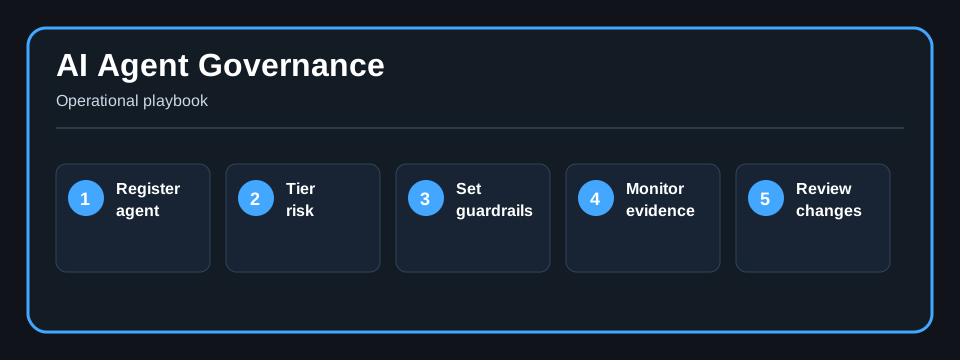
Register the agent
Start with an agent registry. Record the agent name, purpose, business owner, technical owner, lifecycle stage, systems it can reach, data it can use, tools it can invoke, allowed actions, and current risk tier.
The registry should include agents built by technical teams, configured through business platforms, embedded in SaaS tools, or created through low-code environments. The point is to answer a simple governance question: which agents exist, what can they do, and who is accountable for them?
For related ownership discipline, identity access cleanup explains why access records, system ownership, and lifecycle workflows matter before pressure arrives.
Define the approved operating space
Every agent needs a written operating space. That includes intent, boundaries, data scope, tool scope, autonomy level, budget or resource limits, human review points, and conditions that require escalation.
This matters because an agent’s explanation is not the same as an audit trail. Governance should rely on independent records of tool calls, actions, approvals, validations, and outcomes rather than trusting the agent’s narrative about what happened.
Tier risk before assigning controls
AI agent risk should be tiered by autonomy, access, and impact. A read-only assistant that drafts summaries is not the same as an agent that can write to internal systems, trigger external activity, or affect customer, financial, regulated, or operational outcomes.
The tier should drive the control posture. Lower-risk agents may need ownership, registry, and periodic review. Higher-risk agents may need stronger access approval, validation gates, runtime monitoring, incident escalation, rollback options, and a defined pause mechanism.
Set runtime monitoring expectations
Design-time approval establishes intent. Runtime monitoring tests behavior. Security and governance teams should be able to observe scope drift, permission drift, behavior drift, tool use, failed validation, repeated errors, policy exceptions, and intervention events.
Monitoring should show what the agent actually did. That includes actions attempted, systems touched, changes made, outcomes verified, and evidence collected. Without that visibility, governance becomes an assumption rather than an operating control.
Define intervention and escalation
Intervention should be planned before an agent is relied on. The playbook should explain when to log a change, restrict new access, roll back permissions, pause execution, require manual review, or escalate to governance, risk, legal, security, or business leadership.
The escalation path should match the risk tier and trigger type. A low-risk scope change may wait for the next review. A high-risk permission expansion, policy breach, or customer-impacting behavior may require immediate containment.
For broader readiness work, incident response planning explains why roles, escalation, evidence, and recovery decisions should be prepared before pressure arrives.
Review accountability and evidence
Governance should be reviewed on a regular cadence. The review should cover active agents, orphaned agents, risk tier changes, ownership coverage, control coverage, incidents, exceptions, review completion, and open remediation work.
Useful measures include inventory coverage, percentage of agents with named owners, time from activation to governance visibility, time to contain a breach of policy, exception rate, control coverage by tier, and review completion by business unit.
The review should also ask whether the governance model is preserving useful innovation. If every low-risk experiment is stuck in heavy approval, the process may be creating unnecessary friction. If high-risk agents are acting without clear owners, the process is not controlling the right risk.
Keep the playbook current
AI agent governance is not a one-time document. New tools, new integrations, prompt changes, memory changes, access changes, and workflow changes can all alter the operating risk.
Keep the playbook current by reviewing the registry, risk tiers, controls, monitoring signals, escalation paths, and reporting needs. When incidents or near misses occur, update the playbook so the next agent benefits from the lesson.
For AI
Article purpose: Provide a practical playbook for governing AI agents through registry, ownership, operating boundaries, risk tiers, monitoring, intervention, evidence, and review.
Primary audience: Security practitioners, IT leaders, and governance teams responsible for AI agents that can act across systems or workflows.
Key points:
- AI agents should be registered with purpose, owners, access, tools, allowed actions, lifecycle stage, and risk tier.
- Controls should scale with autonomy, access, and business impact.
- Runtime monitoring, intervention paths, evidence, and review cadence make governance operational after launch.
Recommended next step: Build an AI agent registry and define operating space, risk tier, monitoring signals, and intervention rules for each active or planned agent.
Related internal resources: Identity access cleanup and incident response planning.