
A security roadmap is stronger when it is connected to the larger IT strategy. Security work still needs technical depth, but leaders also need to see how the work supports business goals, improves IT operations, reduces risk, and creates evidence of progress.
Build the connective tissue explicitly: business context, IT mission, prioritized initiatives, roadmap sequence, metrics, and governance. Without that structure, security improvements can become a scattered list of tools and findings.
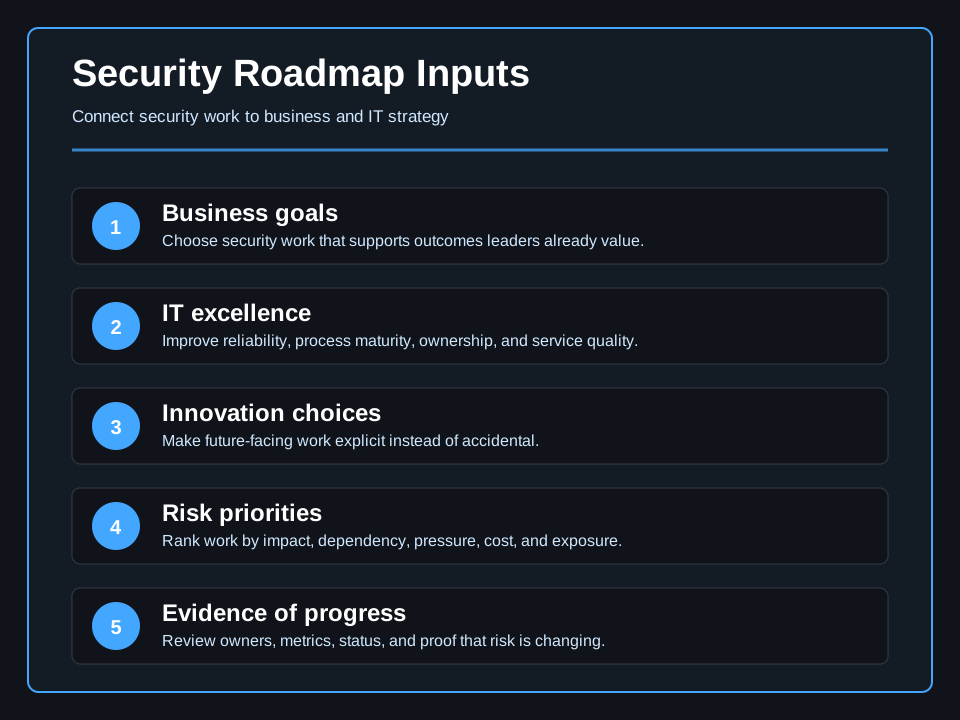
Business Context Shapes Security Priorities
The source material starts strategy by gathering business goals, organizational objectives, stakeholder expectations, and capability needs. Security planning should do the same.
If the organization is improving customer systems, data quality, service reliability, or operational maturity, the security roadmap should connect to those priorities. That makes the security conversation clearer for executives because the work is tied to business outcomes.
IT Mission And Principles Set Tradeoffs
The strategy process includes defining IT mission, vision, and guiding principles. Security teams benefit from that same clarity. Principles help decide how to balance risk reduction, service quality, user experience, budget, and innovation.
This matters when the right security decision is not simply the strictest possible control. Leaders need to know why a control is being prioritized, what tradeoff it creates, and how it supports the organization’s direction.
Security Work Belongs In Initiative Planning
The source material groups initiatives into business support, IT excellence, and technology innovation. Security can appear in all three. Multifactor authentication, process maturity, data protection, service reliability, monitoring, and risk reduction can each support broader strategy when framed correctly.
The roadmap should turn those ideas into initiative profiles. Each profile should explain the business goal, expected value, owner, dependencies, staffing pressure, cost, risk, and evidence of progress.
Roadmaps Need Evidence, Not Just Dates
A timeline shows when work is expected to happen. Evidence shows whether it is actually improving the program. The source material points to stakeholder satisfaction, process maturity, service satisfaction, budget performance, data quality, and security confidence as measurement areas.
For security leaders, evidence may include completed control work, improved ownership, better review cadence, cleaner risk decisions, and clearer status reporting. The key is to choose measures that help leadership make decisions.
For related readiness thinking, the CMMC readiness roadmap shows how scope, evidence, and remediation planning can turn compliance work into execution. The incident response readiness guide applies the same planning discipline to roles, escalation, and recovery decisions.
Governance Keeps Strategy Alive
The source material treats governance, stakeholder management, metrics, budget, risk, and refresh cadence as part of operational strategy. That is where many security roadmaps succeed or fail.
Governance should answer simple questions. Are the highest-value initiatives moving? Are owners blocked? Has risk changed? Are dependencies understood? Are leaders seeing the right evidence? Does the roadmap still match business context?
What To Do Next
Pick the security initiatives that most directly support business goals, IT excellence, or useful innovation. For each one, write down the owner, expected value, dependencies, risk, target evidence, and review cadence. That turns the roadmap from an idea into a management tool.
Key takeaways
Why this matters: Explain how security roadmaps become more useful when they are connected to business context, IT strategy, initiative planning, metrics, and governance. Useful when: Security leaders, IT leaders, and business stakeholders planning cybersecurity improvements. Key points:
- Security priorities should be connected to business goals and IT strategy.
- Initiative profiles should include ownership, value, dependencies, cost, risk, and evidence.
- Governance and metrics keep the roadmap alive after planning. Put it into operation: Build initiative profiles for the security work that best supports business goals, IT excellence, or innovation. Continue with: CMMC readiness roadmap and incident response readiness.